Followers

Thursday, January 4, 2024

Gallimaufry#108

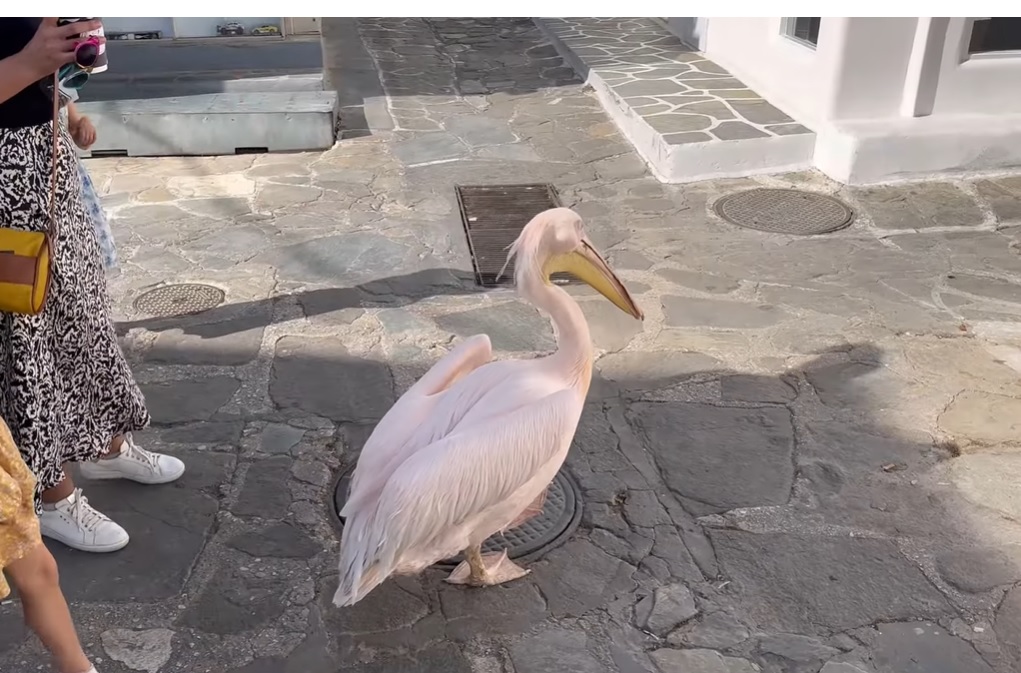
We were having lunch in a taverna when Petros, the pelican, waddled past our table and headed straight into the kitchen. I was expecting the kitchen staff to shoo him off, but I was surprised to see that no one batted an eye. It seemed like his presence in the kitchen was a regular occurrence, a part of the taverna's daily routine. Then, as if on cue, the taverna owner took out a fish from the fridge and fed it to Petros, treating him like an honored guest.
In 1958, a local fisherman discovered an injured pelican and tended to its wounds, nursing it back to health. Embraced by the people of Mykonos, the pelican was affectionately dubbed Petros (Peter), a playful reference to the Greek word "petro" which translates to "rock" or "stone," often used metaphorically to signify someone old and grumpy. However, after a year, Petros met a tragic end, with conflicting accounts suggesting either a fatal encounter with a drunk tourist or being struck by a car.
Despite the loss, the islanders sought to uphold Petros's legacy by introducing a successor bearing the same name. Later, Jackie Kennedy contributed another pelican named Irene to the island. The exact count of Petros's successors remains uncertain, yet pelicans have become an enduring part of Mykonos's local customs and traditions.
Today, the legacy lives on as not one, but three pelicans take up residence and freely roam the streets of Mykonos town.

With an air of regal nonchalance, Petros strolls all over the town, commanding attention with every step he takes. He has mastered the art of posing for photos, apparently aware of the admiring gazes and clicking cameras that follow his every move. Tourists flock around the feathered celebrity, eager to pet and capture a selfie with him.
Petros seems to revel in the attention and enjoys being petted. And he willingly obliges when tourists approach him for selfies.

Here's another pelican who stole my heart—Willie from St. James Park, London.

FUN FACT

Pelicans do have a curious and sometimes playful nature, which can lead to moments where they might appear to pose for photographers. They often exhibit interesting behaviors like tilting their heads, spreading their wings, or staying still for extended periods, which can make it seem as though they're striking a pose. It's more about their natural behavior than a conscious effort to pose for photographers.

My Corner of the World

Friday, December 29, 2023

Gallimaufry#107

THE FRIENDLY STREET CATS OF GREECE
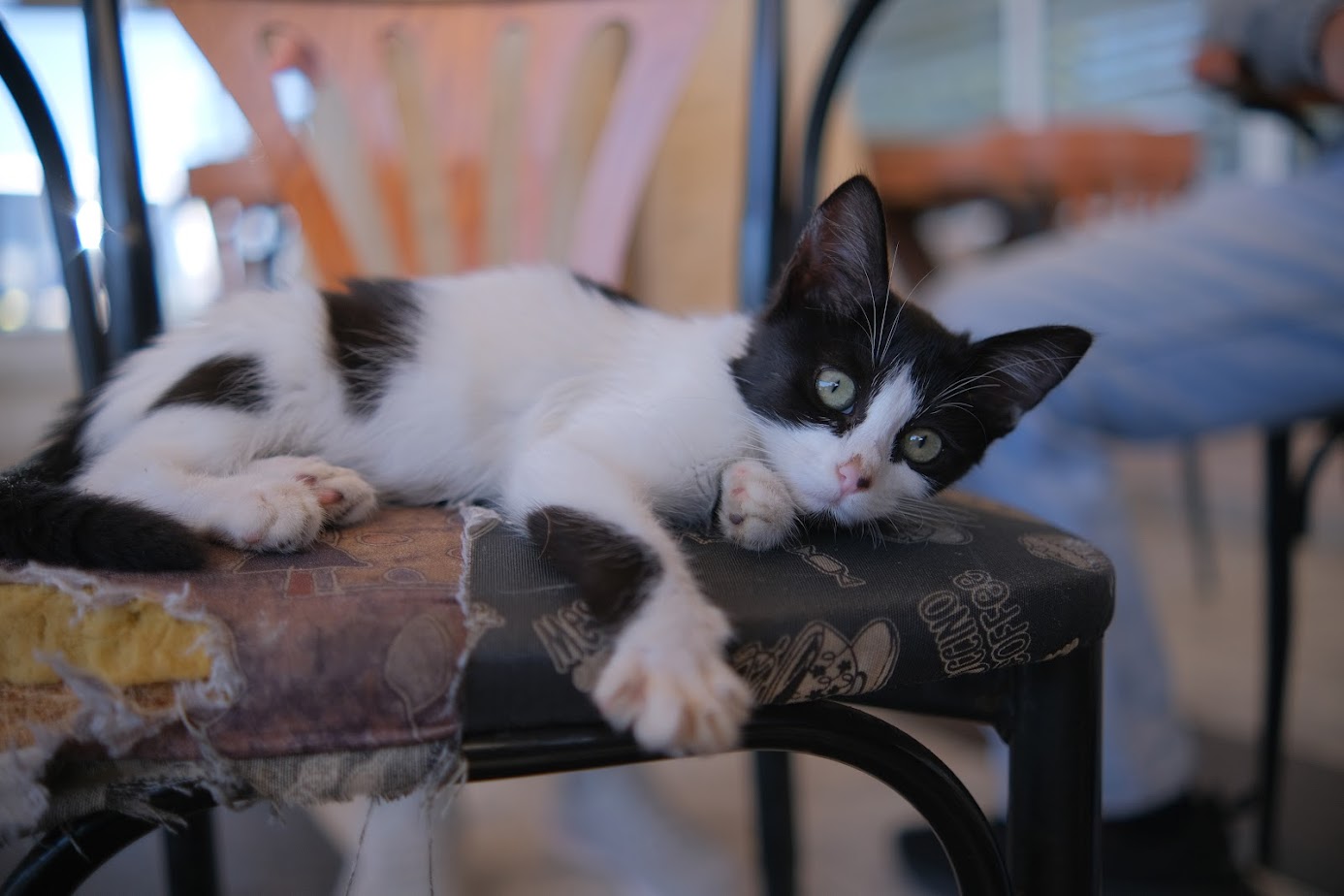
The first thing that struck me upon arriving in Greece was the ubiquitous presence of stray cats. They lounged lazily in the shade of ancient ruins, perched majestically on whitewashed walls, and napped amidst the array of souvenirs in shops. Weaving their way through the legs of chairs, tables, and yes, humans, in bustling tavernas, these feline denizens invite companionship and capture the hearts of all fortunate enough to cross their paths.😺
 

What sets them apart is their remarkable openness to human affection. With a nonchalant grace, they saunter up to curious strangers, welcoming gentle strokes and tender caresses without a hint of reservation.
They seem to be an integral part of Greece's charm, making their appearances in the most unexpected places, almost like ambassadors extending a warm and playful welcome to tourists exploring the country.
Stray, abandoned, and feral cats roam throughout Greece and its islands, often born in spring and sustained by the generosity of tourists who provide them with food. When the summer season ends and tourists depart, these cats rely on the kindness of local Greeks to survive.
Most cats in Greece aren't domesticated. However, for the most part, their presence is accepted by the human population. In some instances, a cat might claim a neighborhood or a dining establishment as its domain, where they know the humans will help care for it.


Kennels for stray cats on a sidewalk
A *clowder of cats
*Such a delightful term for a group of cats
My Corner of the World

Tuesday, December 19, 2023

Gallimaufry#106

THE FERRY RIDE FROM HELL
I thought the ferry ride from Port Piraeus to Mykonos would be fun. I imagined sailing in the caldera with the sea breeze tousling my hair as I gazed upon the azure waters over the railing.

Boy, was I wrong!  Turned out, it was a stomach-churning experience, leaving me clinging to the railing for dear life!

Boarding the Seajets ferry was anything but fun. First, you have to wait for hours in the scorching Greek sun, and then it's a mad stampede to get on and off! Never mind the seasickness!
It was like a refugee scramble—no clear instructions, everyone jostling and dragging their luggage to get on board. The cacophony—the roar of the ferry's engine, the chatter of excited voices, and the clatter of rolling suitcases—amplified the pandemonium.


After boarding, we were required to store our large luggage on one of the racks in the car deck—a frenzied free-for-all as passengers clambered and clamored for space to shove their luggage onto the limited racks.
Finding my sea legs on the swaying deck amidst the intoxicating diesel fumes and battling the urge to keep my breakfast down was a daunting challenge.
The ride certainly is not for the faint of heart! The first part of the journey was relatively smooth, and we did enjoy the magnificent views of the Greek coastline. However, as the ferry moved farther into the open waters of the Aegean, the adventure took a dramatic turn. The wind picked up, and the sea became choppy. The vessel started to rock, and passengers were gripping their seats or the nearest railing. It felt like a never-ending series of peaks and troughs. The hubs and Son #2, who weren't prone to motion sickness, were green in the face! 
Disembarking was absolute mayhem as passengers frantically made a beeline for the car deck to retrieve their luggage. In the midst of this commotion, I became separated from my family and panicked big time! Fortunately, I spotted the flag our tour guide was waving high above the sea of people, and I weaved through the crowd to rejoin the rest of our group. As we impatiently waited to exit the ferry in the confined space, people were swaying into one another. Once the hatch opened and the ramp lowered, a stampede ensued as the mob surged down to solid ground. The scene was apocalyptic!

What an ordeal! And we had to relive the nightmare a second time, from Mykonos to Santorini. Despite the allure of the beautiful Cyclades, I never want to endure that ferry ride again. I'd rather swim!

Wednesday, December 13, 2023

Gallimaufry#105

Day 8—ACROPOLIS and PLAKA

Our last day in Greece.

Breakfast—Koulouri Thessalonikis
ACROPOLIS

image source - smarthistory.org
FUN FACTS ABOUT THE ACROPOLIS & PARTHENON IN ATHENS

The Parthenon's age surpasses 2,460 years. Historical records indicate its construction began around 447 BC.

The Parthenon has served as a temple, a church, and a mosque over time. Initially devoted to the Greek goddess Athena, it underwent transformations as various religions claimed ownership. Christians converted it into a church, and later, the Turks transformed it into a mosque, adding a minaret atop the structure.
The Parthenon suffered destruction when explosives stored within its walls detonated during the late 1600s amid the conflict between the Venetians and Turks vying for control over Athens. This occurred as the Acropolis, due to its elevated position, served as a strategic military site during the conflict.
The Erechtheion
The Six Cariatids of the Erechtheion
A cariatid is a stone carving of a draped female figure, used as a pillar to support the entablature of a Greek or Greek-style building. Different interpretations exist regarding the identity of the six caryatids, with some suggesting they represent Greek goddesses, while others propose they depict the women of Caryae, who were doomed to hard labour because the town sided with the Persians in 480 bc during their second invasion of Greece.

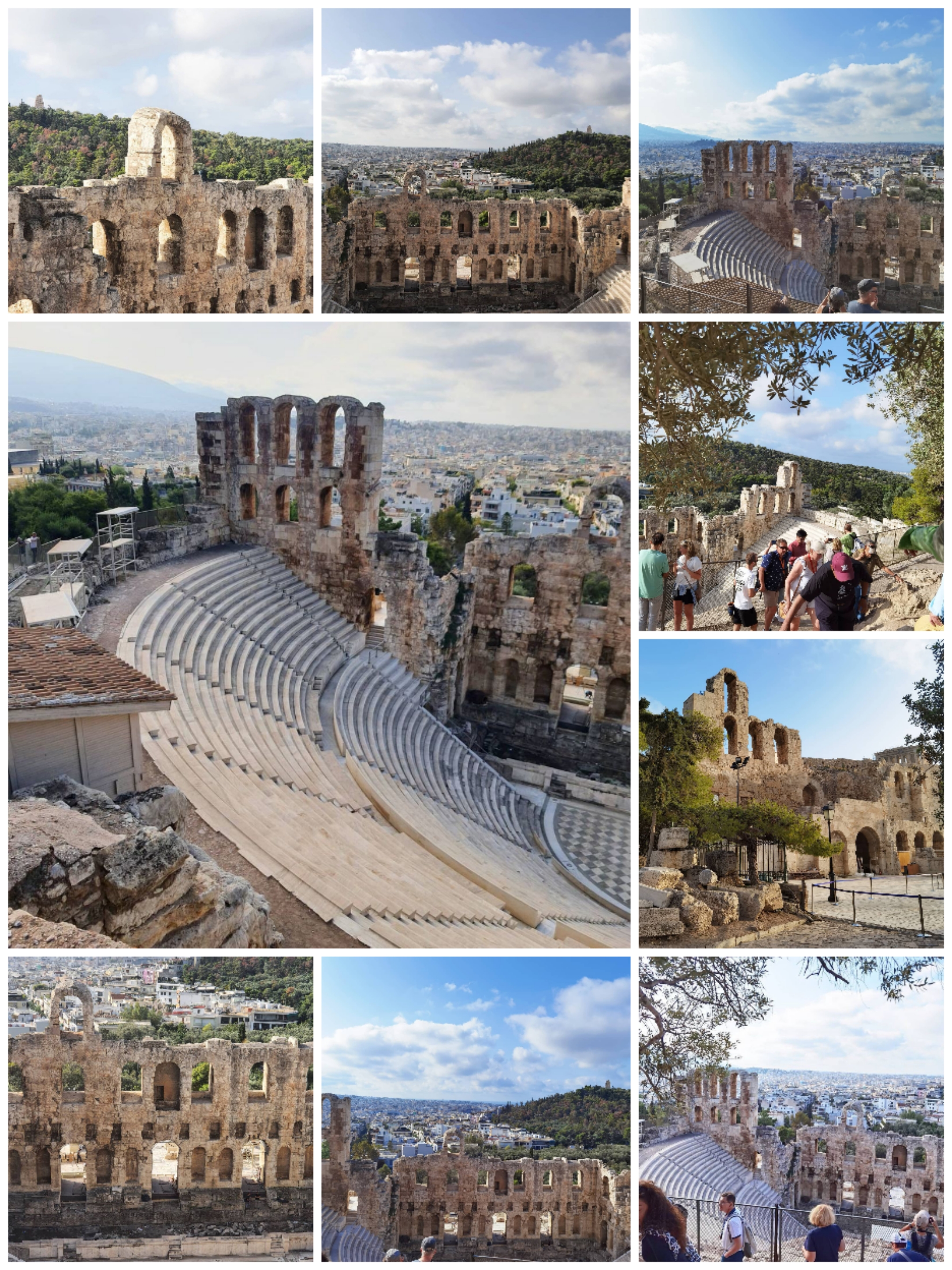
Odeon of Herodes Atticus 
The odeon  was built in AD 161 by Herodes Atticus in memory of his Roman wife, Aspasia Annia Regilla.
 It was originally a steep-sloped theatre with a three-story stone front wall and a wooden roof made of expensive cedar of Lebanon timber. It was used as a venue for music concerts with a capacity of 5,000.


Aeriel view of the city of Athens
A 19th-century drawing of what the Propylaea might have looked like when intact.
image source - wikimedia

Beulé Gate
Entrance leading to Propylaea

Propylaea

Exiting the Beulé Gate. 

Sculpture of Menander (Meandros)—one of the most important dramatists of the ancient world.
Ancient finds near the Theater of Dionysus


PLAKA

The statue of Ioannis Makriyiannis guards the entrance to the Plaka neighbourhood.


The famous Plaka stairs lined with cafes and tavernas.
Choragic Monument of Lysicrates
A couple of street kids drumming, their talent overshadowed by the necessity to beg for survival.

Cats graced us with their presence everywhere we went! I have a whole lot of photos of moggies we encountered in Greece, which I will share in a future post.

Our last meal in Greece before heading for our flight home.  A Chinese lunch!
Haha! We took a "wok" down memory lane with our fellow travelers as we shared photos and swapped social media accounts.

Final glimpses of Greece en route to the airport.
Clockwise—Panathenaic Stadium, traditionally costumed evzones (presidential guards) standing by the Tomb of the Unknown Soldier, Syntagma Square

Goodbye, Greece! It was truly a trip of a lifetime, filled with unforgettable moments and cherished memories that will forever hold a special place in our hearts.

My Corner of the World